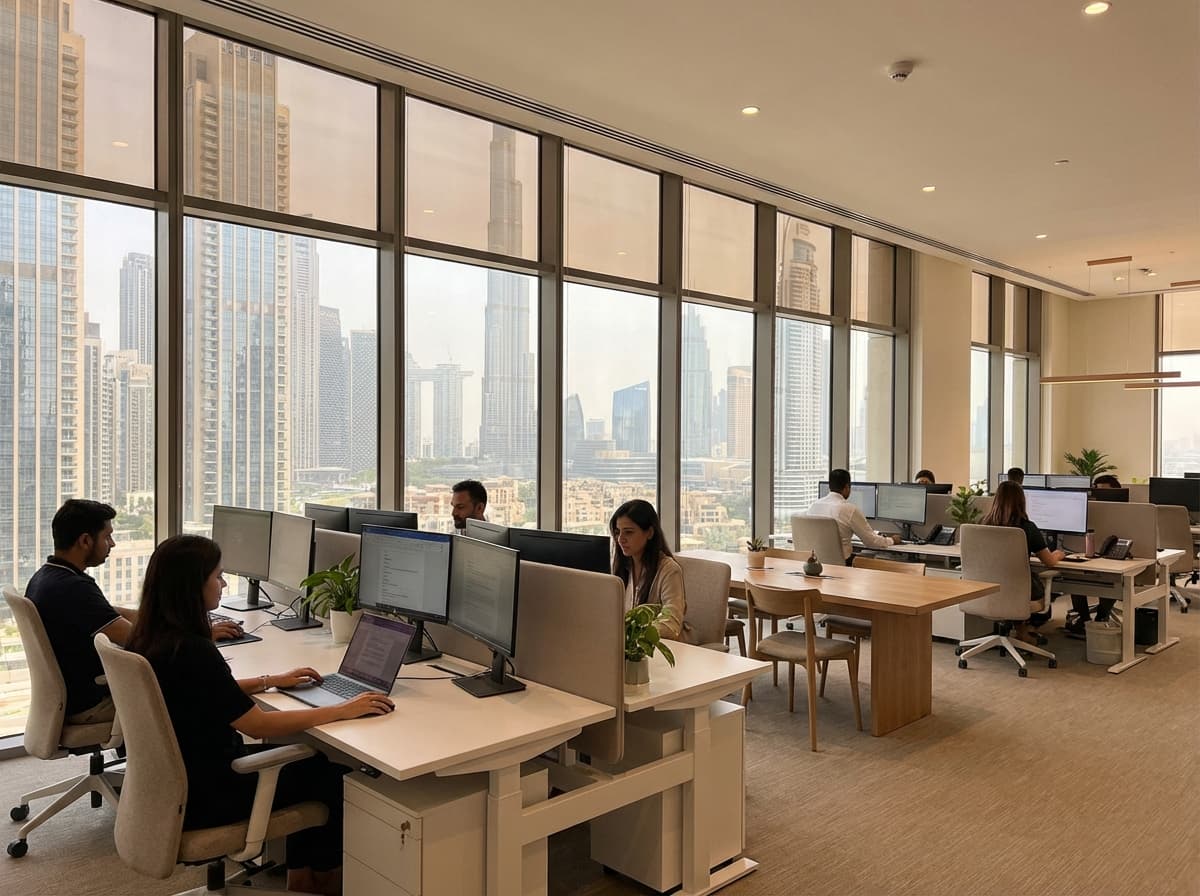
Heat Reduction Film in Dubai
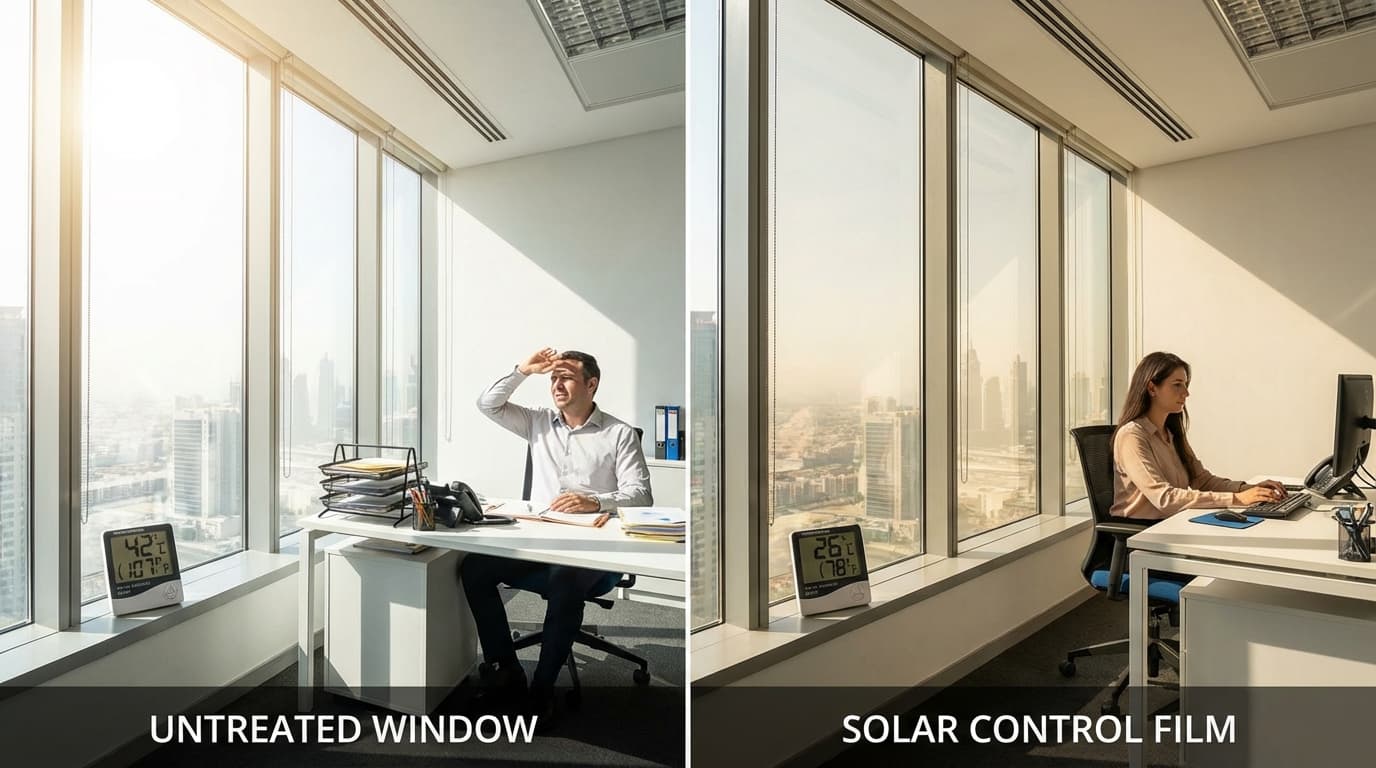
Heat rejection window film for Dubai commercial buildings: solar control films that reject up to 79% of total solar energy while keeping natural light. Reduce AC load by 25-35% and make every seat usable, including the south-facing window desks staff avoid from May to September. Untreated commercial glass transmits 70 to 80% of solar energy as heat. A spectrally selective ceramic film at TSER 65 to 79% cuts that to 21 to 35%, reducing peak HVAC load on treated facades by 25 to 35%. This is not automotive tint. Dyed tint darkens glass and discolours within two to three years on a Dubai facade; spectrally selective heat rejection film targets the infrared wavelengths that carry heat, so the glass stays clear at 40 to 65% visible light transmission while the heat stays outside. At DEWA Slab 3 commercial tariff rates of AED 0.38 to 0.44 per kWh, a 500 sqm south-facing office floor can realise AED 4,000 to 8,000 in annual cooling cost reduction, and the same physics holds across the UAE under ADDC and SEWA tariffs. Installation takes one to two working days per floor with no disruption to occupants. Nano-ceramic film options carry no metallic layer, so mobile and WiFi coverage on treated facades is unaffected. All commercial-grade films carry manufacturer warranties of 10 to 15 years against delamination, bubbling, and colour change. Pricing from AED 250/sqm installed for offices, hotels, retail, and warehouse units in Dubai, Abu Dhabi, and Sharjah, with a free site survey and a fixed written quotation before any commitment.
What You Get
- Up to 79% solar heat rejection (TSER)
- 99% UV protection — prevents fit-out fading
- 25-35% reduction in DEWA cooling costs
- Maintains 40-65% visible light transmission
Quick Facts
- Ideal For
- Office towers, co-working spaces, hotel lobbies, retail on south/west facades
- Starting Price
- AED 250/sqm
- Installation Time
- 1-2 days for typical office floor
- Warranty
- Up to 15 years manufacturer warranty
This film is also available for homes and villas. See residential pricing at residentialwindowtinting.ae
Heat Reduction Film FAQ
How much heat does solar control film reject on a Dubai office facade?
High-performance ceramic solar control films reject up to 79% of total solar energy (TSER) on south and west-facing commercial glazing. Entry-level solar control film at TSER 45 to 55% is sufficient for north-facing glass where heat is a secondary concern. During the site survey, we assess your glass type, orientation, and existing coatings and recommend the optimal film specification to maximise heat rejection without reducing visible light below acceptable levels for your use case.
Will heat reduction film make my Dubai office too dark?
No. Nano-ceramic solar control films reject infrared heat through molecular absorption and reflection rather than blocking visible light. Our most popular commercial specification maintains 45 to 60% visible light transmission (VLT) while rejecting 65 to 79% of solar heat. Your office stays bright and naturally lit. We bring physical film samples to every site survey so you can assess VLT on your actual glass in natural light before committing.
How much can a Dubai office building save on DEWA bills with heat reduction film?
A south or west-facing Dubai office floor with 500 sqm of glazing at TSER 65% film typically reduces peak cooling load by 35 to 45 kWh per day in June to September. At DEWA commercial Slab 3 rates of AED 0.38 to 0.44 per kWh, that is AED 1,800 to AED 2,400 in direct summer savings. Including shoulder months, full-year savings typically run AED 2,500 to AED 4,500 for this floor size. For a detailed payback model see our window film energy savings Dubai guide.
How much does commercial heat reduction film cost per sqm in Dubai?
Commercial heat reduction film starts from AED 250 per sqm installed for standard solar control. High-performance ceramic film at TSER 65 to 79% runs AED 320 to 450 per sqm. A typical single office floor of 400 to 600 sqm of treated glass runs AED 128,000 to AED 270,000 installed. Access conditions (high-rise requiring Building Maintenance Unit or cherry picker) add AED 30 to 120 per sqm. We provide a fixed written quotation after a free site survey with no obligation.
Does heat reduction film interfere with WiFi or mobile signals in Dubai offices?
Nano-ceramic solar control films use no metallic layer and produce zero signal interference with mobile phones, WiFi, or GPS. Older sputtered metallic films (silver reflective) can reduce signal strength by 5 to 15% through treated glass. For tech offices, trading floors, and co-working spaces in TECOM and Dubai Internet City where network performance is critical, we specify non-metallic ceramic film by default.
What is the difference between heat rejection window film and window tint in Dubai?
Automotive-style window tint is a dyed film that darkens glass and absorbs some heat. Commercial heat rejection window film is spectrally selective: it filters the infrared wavelengths that carry solar heat while passing most visible light. A treated office facade rejects 65 to 79% of total solar energy at 40 to 65% visible light transmission, where a dyed tint reaching similar heat numbers would leave the space noticeably darker. Dyed films also discolour within two to three years under Dubai UV, while ceramic heat rejection films carry 10 to 15 year manufacturer warranties.
What is spectrally selective window film?
Spectrally selective film treats different wavelengths of sunlight differently: it passes most visible light and reflects or absorbs the near-infrared band, which carries roughly half of the sun's heat energy. On commercial glazing the result is high heat rejection with minimal visual change. The 3M Prestige and Solar Gard HP series we install in Dubai offices reach TSER 65 to 79% while keeping glass close to clear. This is the default specification for curtain wall towers where building management restricts visible changes to the facade.
Does heat rejection window film work outside Dubai in the UAE?
Yes. We install commercial heat rejection film across the UAE, including Abu Dhabi, Sharjah, and the Northern Emirates, where peak solar radiation matches Dubai at 900 to 1,100 W/m² and ADDC and SEWA tariffs make the cooling payback case equally strong. Warehouse and industrial units with translucent panels or large glazing see interior temperature drops of 8 to 12°C on treated surfaces. See our commercial window film Abu Dhabi guide for emirate-specific pricing and NOC requirements.
Get Your Free Commercial Quote
Send us your building details on WhatsApp and we'll arrange a free site survey within 48 hours. No obligation, no pressure.
Or call us directly at 052 315 1530